Startups do not die because founders fail to hear about validation. Every accelerator teaches it, every blog preaches it, every founder can recite "validate before you build." Startups die because by the time validation would matter, the founder no longer wants to hear the answer.
Somewhere between the first spark of an idea and the first working version of a product, curiosity hardens into emotional commitment. And commitment, the very force that carries entrepreneurs through hardship, becomes the force that blinds them to evidence. This was always true. AI made it categorically worse, because AI collapsed the time between idea and tangible product from months to a weekend, and tangibility is the trigger that converts curiosity into commitment.
The old cost of building was, accidentally, a validation buffer: it forced a pause in which doubt could still do its work. That pause is gone. Founders now reach the point of emotional no-return before they have encountered a single piece of real market evidence. Everything that follows - the marketing spiral, the feature treadmill, the escalation, the noisy pivot - is downstream of that one mis-timed moment.
The disease was never ignorance
CB Insights' long-running analysis of startup post-mortems found that the single most common reason startups fail is "no market need," cited in roughly 42% of failures in the original multi-year study. When CB Insights updated the work across 431 VC-backed companies that shut down in the post-2023 shakeout, the headline barely moved: 43% failed on poor product-market fit, and two-thirds of those were early-stage companies that never found a market at all.
Now hold that against a second fact: validation advice is everywhere. Steve Blank's customer development, Eric Ries's validated learning, a decade of Lean Startup curriculum in every accelerator on earth. The information problem was solved years ago. If nearly half of startups still die on a question that could have been answered before a line of code was written, the explanation cannot be that founders don't know they should ask it.
The explanation is that knowing and being able to act on the knowing are different states. The founder who skips validation is usually not uninformed. They are committed. And a committed mind does not process evidence the way an uncommitted mind does. It defends. It rationalizes. It reinterprets silence as "early days" and rejection as "wrong segment." This is documented, replicated human psychology, and it operates on the strong founders most of all - because the same conviction that makes a founder formidable makes their commitment harder to dislodge.
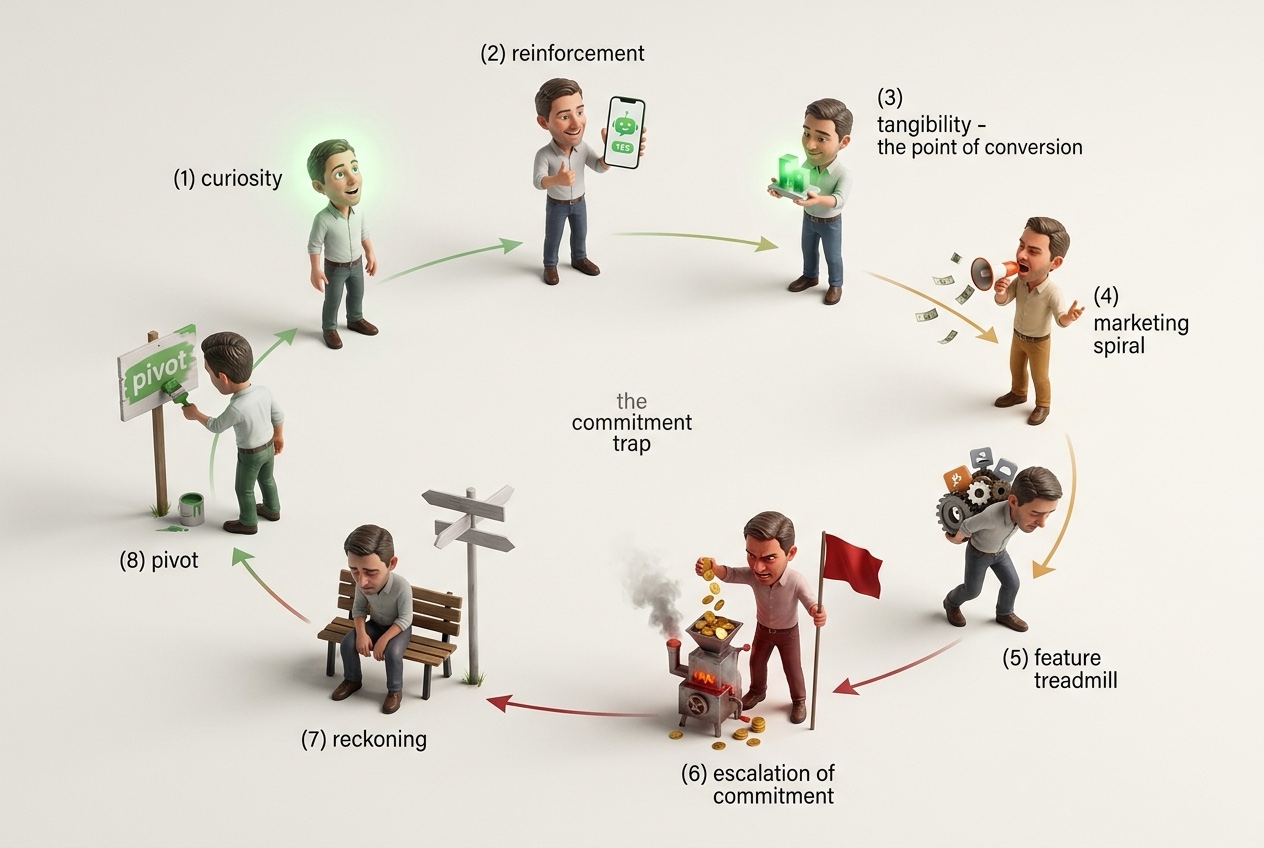
The commitment curve:
how curiosity becomes blindness
The arc is so consistent it can be narrated like a case study, because it effectively is one - assembled from thousands of post-mortems that all tell the same story in different words.
Curiosity
A founder has an idea. At this moment, and only at this moment, they are genuinely open. The idea is a hypothesis, held lightly. They would drop it if given a good reason. This is the golden window, and it is brief.
The first reinforcement
The founder tests the idea against whatever is nearest: friends, family, and increasingly, an AI chatbot. Friends are polite. Family is supportive. And the AI, asked "is this a good idea?", performs its default motion: it finds reasons to say yes. None of these responses carry information - the people are on your side, not in your market, and the model is optimized to be agreeable - but all of them carry emotional weight. The hypothesis starts feeling like a plan.
Tangibility
The founder builds something. A landing page, a prototype, an MVP. The moment the idea takes physical form, something psychologically decisive happens: it stops being a hypothesis and becomes a possession. Consumer psychology has a name for this - the IKEA effect (Norton, Mochon & Ariely, 2012), which showed across four studies that people value things they built themselves far above identical things built by others. Labor leads to love. The founder has now laboured, and the love arrives on schedule. Note carefully what has and has not happened: the founder has built, named, and fallen in love - without once asking what the market has already said about ideas like this.
The marketing spiral
From here, the question silently changes. It is no longer "does the market want this?" It is "how do I make the market see this?" The decision that the idea works has already been made, invisibly, somewhere around Stage 3. Hours go into organic marketing. Then money goes into paid. Results are never instant, so effort escalates - and every dollar and hour deepens the investment that will later have to be defended.
The feature treadmill
When growth disappoints, the committed mind chooses the explanations that preserve the core belief: the marketing isn't right yet, or the product is missing something. So the founder markets harder and builds more. Note the structure: growth proves it works; no growth proves it needs more work. Every outcome confirms the plan.
Escalation
Months in, resources draining, the founder faces a choice behavioural science has studied for fifty years. Barry Staw's landmark 1976 study, "Knee-Deep in the Big Muddy," found the signature result: people commit the greatest additional resources to a failing course of action precisely when they feel personally responsible for it. Personal responsibility plus bad news does not produce retreat. It produces reinvestment. It connects to sunk-cost dynamics and to cognitive dissonance: admitting the idea failed means admitting the self was wrong, and the mind will spend astonishing resources to avoid that admission.
The reckoning, and the noisy pivot
Eventually, drained, the founder finally asks the question that belonged at the beginning: was the market ever there? Sometimes the answer is accepted and the idea is dropped and the founder is free. But often there is one more move that lets the commitment survive: the pivot. A pivot grounded in real evidence would be wise. But most pivots at this stage are not grounded in anything - they are built on noise, interpreted by a mind desperate for a reason to keep going. That pivot is escalation of commitment wearing a strategy costume. The founder builds again, markets again, commits again, and the curve restarts, this time with less money, less energy, and less confidence than before.
The answer?
The intervention has to happen before the idea becomes a possession, while doubt can still do its work. That is the entire reason Greenlight exists. We don't ask you to commit less. We ask you to commit in the right order: before you build or emotionally commit, get a reality check - your market, your own fit against it, and what actually happened to more than 10,000 founders who walked this path before you. The market has already spoken about ideas like yours. Reading what it said takes five minutes. Do it before you fall in love with your idea.
Here is why we built the opposite.
The people who build the AI models have warned about it. But founders are the worst-placed people on earth to hear it.
Read the article →Every idea-stage admission is a founder-market fit bet made on instinct. The information could arrive much earlier than it does.
Read the article →